Charge and go! An e-truck or electric aircraft needs to keep moving
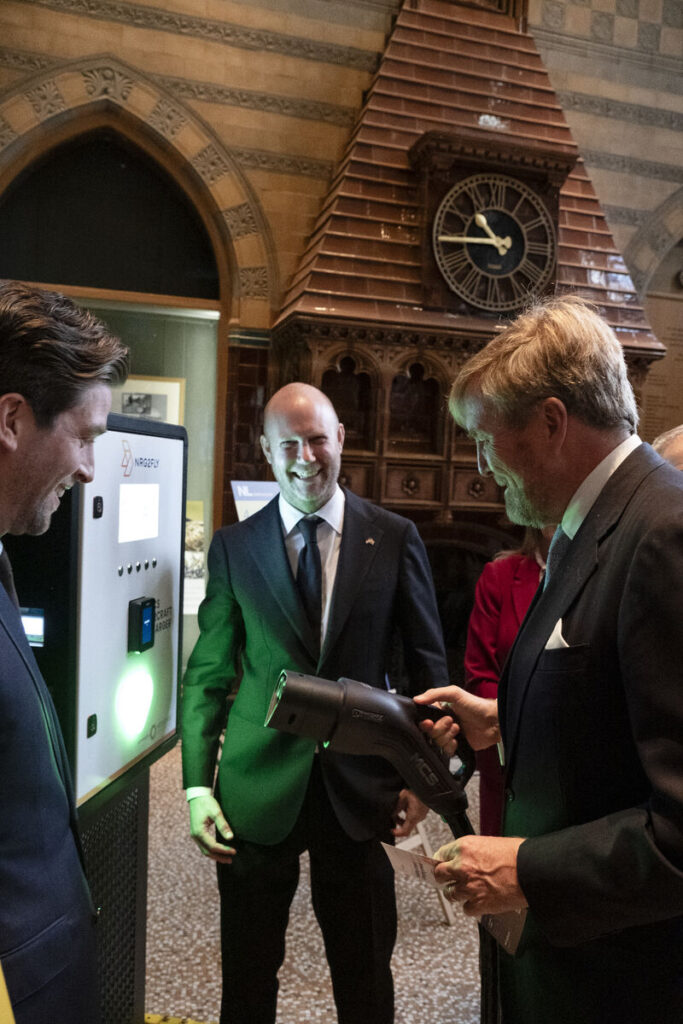
The King holding your charging connector. That doesn’t happen every day!
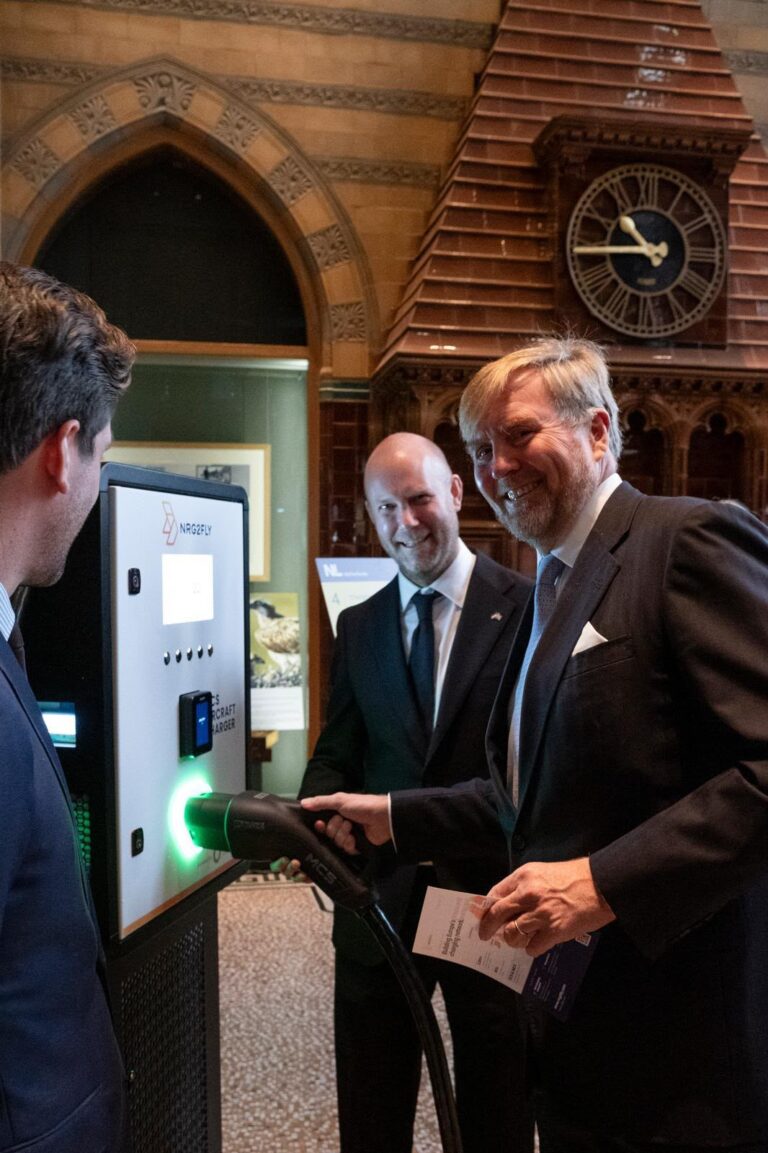
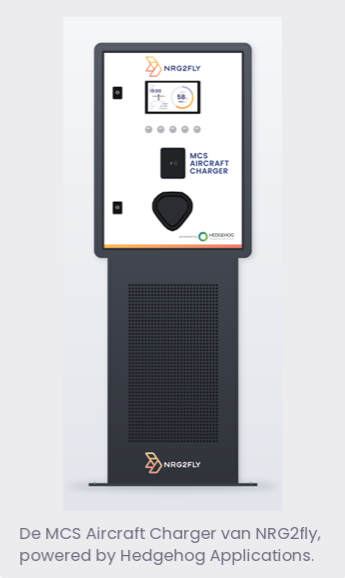
It was Hedgehog Applications’ specially developed MCS charger that NRG2fly presented to King Willem-Alexander in Liverpool. A charger designed to charge electric aircraft at megawatt power levels in other words, very high power.
But why would we at Hedgehog Applications also use our charging technology in aviation? Quite simply:
- Both e-trucks on the road and electric aircraft between flights need to charge quickly and get moving again.
- Fast charging requires a lot of power, often in places where the available grid capacity is limited.
Two challenges we know very well from the transport sector. Let’s take a closer look at them.
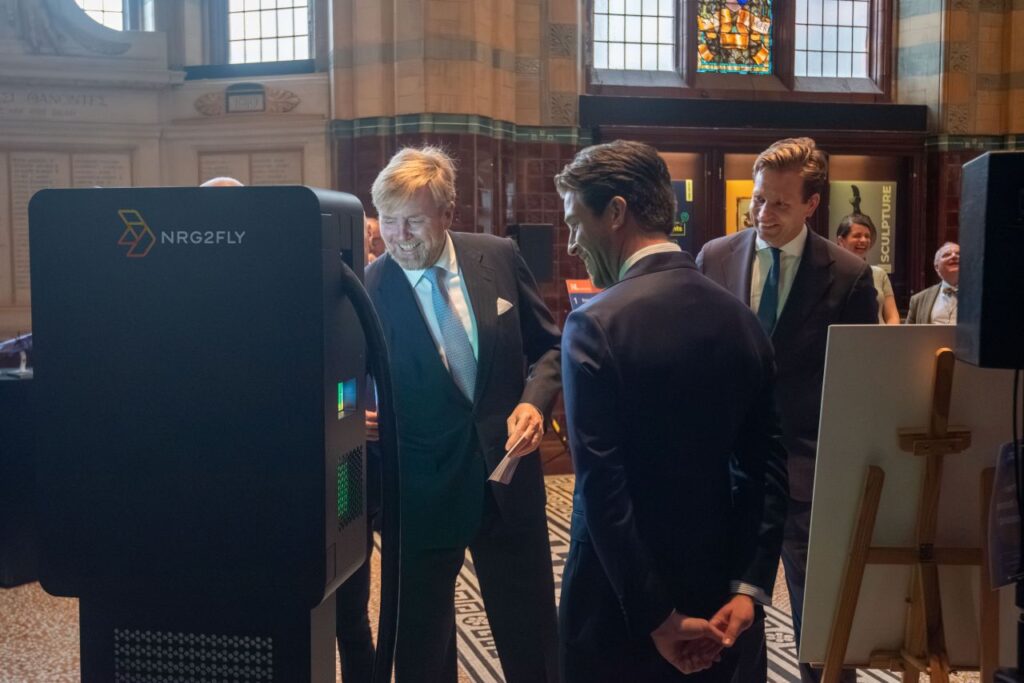
King Willem-Alexander, Minister Vincent Karremans (Infrastructure and Water Management), Keir Mather (UK Transport) and Sjoerd Sjoerdsma (Foreign Trade), together with our charger and charging connector. And with a pilot in the group, we hardly need to explain how important it is to be able to depart on time. 😉
Charge and go
An aircraft charging between two flights needs to get moving again quickly. Time is money. The same applies to an e-truck charging on the road. Every unnecessary minute standing still costs money and can affect the planning.
And you need to be able to rely on the charging solution. That sounds obvious, but it is not always a given. If something does go wrong, you want to know quickly where the problem is and how it can be fixed. It is therefore about getting enough energy into the vehicle within the time available. If a truck is parked at the depot all night, there is more flexibility. But if an e-truck needs to get back on the road after a short stop, it needs to take on enough energy within that window. For an aircraft between two flights, the principle is no different.
That is where our Sonic Core comes in. It provides local monitoring and control of the chargers and other parts of the energy system. This allows us to see what is happening and investigate exactly where a problem occurs. After all, you want to get charging again as quickly as possible. And get moving.
We develop and build our technology ourselves, together with our partners. That means we understand both the hardware and the software. And that helps when something needs to be solved.
Because ultimately, a driver or pilot mainly wants to know one thing: when can I get moving again?
Available power
If you want to put a lot of energy into a vehicle in a short amount of time, you need high charging power. There is no way around that. At megawatt charging levels, you are talking about 1,000 kW or more. That level of power is not readily available at every location. Especially when several trucks or aircraft need to charge at the same time and the rest of the site is using electricity too.
Both aviation and road transport have peaks and dips in electricity demand. One truck may be parked for hours, while another needs to leave again quickly. At an airport, arrival and departure times determine when charging needs to take place. These different requirements create different charging profiles: how much energy is needed, when is it needed and how much time is available to charge?
By looking carefully at those questions, you can distribute the available power more effectively. What needs to charge now, and what can wait? And could a battery help by storing energy during quieter periods and supplying it during a charging peak?
A battery does not create extra electricity. There still needs to be enough energy available over the course of the day to recharge it. That is why we look at the full picture: the schedule, the grid connection, other electricity use and the energy required for charging.
That is exactly where the comparison with road transport comes in. A powerful charger matters, but the power also needs to be available at the right moment.

Maarten at our project at Teuge Airport in Gelderland.
But can you really fly electric?
Electric aircraft are being developed for short, regional flights. But once an aircraft arrives, it also needs to recharge sufficiently for its next flight. Otherwise, you cannot run a reliable schedule. That means airports need the right charging infrastructure too.
To demonstrate how this could work in practice, we developed and built a dedicated MCS charger for NRG2fly. During the demonstration in Liverpool, NRG2fly presented it alongside a simulation on a screen. The simulation showed how an aircraft could be ready to depart again within thirty minutes of arrival, including charging.
No aircraft was actually charged during the demonstration. But the combination of the charger and the simulation clearly showed what is required between two flights. How much energy needs to be added? How much time is available? And how much charging power is needed?
Exactly the same questions a transport operator faces. Because whether you need to make the next flight or the next delivery, the schedule still has to work.
Built for NRG2fly, backed by more than 13 years of experience
We did not start from scratch with this charger. At Hedgehog Applications, we have been working on charging technology and energy systems for transport and mobility for more than 13 years. We used that experience to develop the charger for NRG2fly.
We know how important it is for the charger, the energy supply and the control system to work together properly. High charging power on paper is great, but you also need to be able to deliver that power on site. And the installation needs to keep working when you rely on it.
NRG2fly brings the expertise in aviation charging. We bring our experience in charging technology, hardware and software. Together, we developed a charger for their application that makes the move towards electric aviation tangible. In Liverpool, that included demonstrating it to King Willem-Alexander.
For transport operators, that is exactly where the value of our experience lies. We look at what is needed to get your trucks back on the road on time. If a standard solution does not fit the planning or the power available on site, we have the technical expertise to adapt it or develop something ourselves.
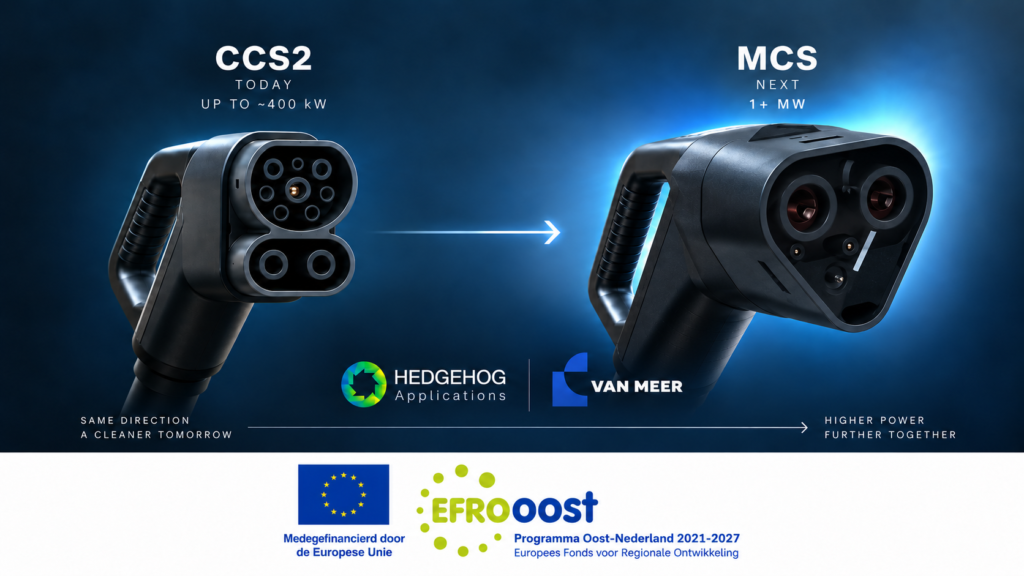
Developing MCS charging further with Van Meer
We are also working with Van Meer on the technology behind megawatt charging. Within the MIGHT-e project, we are developing an integrated charging solution for electric trucks that need to recharge quickly while on the road.
Reliability, efficiency and robust technology that can handle demanding conditions are central to the project. Exactly the same issues that matter when charging aircraft.
MIGHT-e is supported by the ERDF East Netherlands 2021–2027 programme and co-funded by the European Union.